Saturday, April 9, 2016

LANCER EVOLUTION X - Body, chassis


Mitsubishi Motors’ corporate philosophy is encapsulated in the following motto:
“We are committed to providing the utmost driving pleasure and safety for our valued cus
tomers and our community. On these commitments we will never compromise. This is the Mitsubishi Motors Way.” 


Key words: Driving Pleasure, Vehicle Dynamics, 4WD System 


Body, chassis, evaluation and analysis

 Indeed, weight reduction, a low center of gravity and a low moment of inertia are all essential for enhanced dynamic performance of a vehicle. However, simply using aluminum materials causes problems with the rigidity of the body, which has a predominant influence on the vehicle’s dynamic performance. We had to work hard to ensure full rigidity of the body in develop- ing the LANCER EVOLUTION X.


As generally stated, the Young’s modulus and specific gravity of aluminum are both one third those of steel, which means that its specific rigidity (ratio of stiffness to weight) is also one third that of steel. If aluminum material were simply applied to the body framework for reduced weight, the body would be less rigid. An aluminum space frame structure uses extruded aluminum materials for the main structural members, taking advantage of the material’s characteristics to overcome such issues that are characteristic to steel monocoque body structures, such as a loss of rigidity at joints and spot welds. In addition to a low moment of inertia due to reduced weight, the aluminum space frame body provides the type of ride that is not possible with a steel monocoque structure. 


Increasing the number of spot welds is a widely known method of increasing rigidity. At MMC, this method was first employed for the LANCER EVOLUTION IV, followed by the FTO, PAJERO, COLT and other ranges. Today, continuous joining methods such as laser welding are drawing increasing attention as substitutes for spot welding. Furthermore, an increasing number of automaker’s are positive about using adhesives in combination with welding. 


Unlike tires and suspensions, it is difficult to logically express the impact of body characteristics on a vehicle’s dynamic performance by using mathematical formulae. In actual testing scenarios, staff traditionally use their senses to identify the vehicle’s dynamic performance.

It is simple to say “the rigidity of suspension mounts”, but it is not simple to define what the phrase means. To begin with, where is the reference point in the coordinates we should use? 


Flexural stiffness and torsional stiffness are typical values that represent the body’s rigidity, but they do not represent everything regarding rigidity. Rigidity is really difficult to express.

Rigidity of the vehicle’s body is difficult to measure. To measure rigidity, the vehicle’s body must be fixed in place, but the measurement results obtained from an improperly fixed body may not be what we need. These may represent other things, and you will not understand exactly what you are measur- ing. We require a method of presenting the force of inertia.
It is important to visually confirm the defor- mation on an actual vehicle body.
In addition to deformation measurement on a body in white (BIW), we used to reproduce the BIW faithfully by using plastic models of individual body parts to see how they deformed. Now, we generally do the same thing on computer screens using CAE technology visu- ally, but the BIW tests were useful to me because I could confirm how those plastic models deformed by physi- cally touching them. It was easy to cause poor structur- al components to deform by applying a force to them (laughter). 


AYC / ACD System


Mitsubishi Lancer Evolution X


ACD/AYC is the system that makes the X the X.


ASC Off = does NOT cut power but still uses individual braking control (not sure if it's all the time or only sometimes)
Hold ASC OFF for 3 sec = no cutting power and no individual braking control

-The MR has 11 pounds more sound insulation than the GSR
-The Enkei cast alloy GSR wheels weigh 22 pounds, while the BBS forged MR wheels weigh just under 20.


AYC / ACD System Explained:

The AYC (active yaw control) and ACD (active center differential) system in the Evolution X is very complicated mechanically and there has been much interest in how to service the system.

There are three main parts of the system:

1) The Transfer Case. This houses the ACD clutch pak and the ACD activation ring piston circuit. It also houses the front differential and parts of the center differential (actual center diff is in Transaxle on both 5 speed and SST).

2) The Rear Differential. This houses the AYC clutch paks (there are two, one for the left wheel and one for the right wheel) and the AYC activation ring piston circuits (there are two as well). It also houses the rear differential.

3) The ACD / AYC Pump. This is in the rear passengers side fender / bumper. This pump produces hydraulic pressure to active the AYC and ACD circuits, which can be as high as 150 PSI. It also has an accumulator to store pressure (around 300 PSI). This pump is connected to the reservoir in the trunk.

ACD - single line, single clutch pack circuit.
AYC - dual line, dual clutch pack (right and left) circuit.


AWC-ECU performs a calculation based on the information from ECU, sensors, and switches. Then, based on the calculation value, it appropriately operates the hydraulic units (for ACD, AYC, ASC, ABS) to control in response to the driver's operations and vehicle behaviors.

Item
Control content
ACD transfer
The basic structure and operation are the same with EVOLUTION IX, but the strength of each part has been enhanced to support the high-powered engine.
AYC differential
The basic structure and operation are the same with EVOLUTION IX, but the strength of each part has been enhanced to support the high-powered engine.
Hydraulic unit (For ACD/AYC)
The basic structure and operation are the same with EVOLUTION IX, but the shape has been changed to accommodate the change of on-vehicle layout.
Hydraulic unit (for ASC/ABS)
In addition to the brake control of ASC and ABS, it also performs the AYC brake control.
AWC-ECU
Based on the information obtained via CAN communication and others, it appropriately controls ACD, AYC, ASC, and ABS.
Sensors
Adding to the sensors (throttle position sensor, G sensor, steering sensor, wheel speed sensor) that provided information to EVOLUTION IX, the following sensors have been equipped: Engine torque sensor, engine speed sensor, yaw rate sensor, and wheel cylinder brake fluid pressure sensor.


Two lines go to the AYC but they are for two different clutches, and one line goes to the ACD. There are NO RETURN LINES.  


With the cornering performance of when vehicle is steered to trace a turning circle of certain radius while the speed is gradually increased, the understeer is further suppressed compared to the ACD/AYC control adopted with EVOLUTION IX,resulting in a further improvement to cornering per- formance. For the quick steering lane change on a slippery road surface, the stability and convergence of vehicle behavior at the completion of lane change have also been improved. 


In addition to the conventional lateral torque movement control, a new brake control has been added to AYC. It is activated near the driving limit range to assist the yaw motion control. 


Brake force is applied to the inside wheels while the vehicle behavior is understeer during cornering, and to the outside wheels when oversteer, achieving the vehicle cornering performance that corresponds to the driver's operation. Also, the spinning of front wheels at vehicle start is suppressed by the brake force, improving the traction performance.
This brake control can be deactivated with the ASC OFF switch.


EFFECTS OF BRAKE CONTROL:
The understeer behavior and oversteer behavior near the driving limit range are further suppressed.

INTEGRATED CONTROL OF ACD/AYC/ASC/ABS:
ASC has been added to ACD, AYC, and ABS that are equipped with LANCER EVOLUTION IX, and an integrated control is performed to enhance the driv- ing performance, cornering performance, and stabil- ity in any driving condition during acceleration, deceleration, and cornering.

ADDITION OF TC-SST CONTROL <VEHICLES WITH TC-SST>:
For vehicles with TC-SST, AWC-ECU communicates with TC-SST-ECU via CAN line to suppress unnecessary gear shifts during cornering which hamper the sport driving.


The main electric pump : operates at 12v (relay circuit) constant, 2-3 amp draw. Operates only when the pressure sensor drops below 2 volts (this means there is less than 150psi left in the accumulator).  

Both gear oil (Diaqueen LSD or equivalent) and ATF fluid (Diaqueen SP3 or equivalent) is used in the system.


The pressure sensor : is supplied with 5v constant, also has it's own ground. It OUTPUTS between .5v-2.7V. The low end of the range means no pressure in the system the higher end reading (2.7v max) is MAX pressure. When it reaches 2.7v and above, it SHUTS down the pump and shuts down the AYC. They call this the "Fail-safe" function.


The AYC proportioning valve : operates between 0-4v. The low end of the range (zero volts) means it's completely closed. The high end of the range (4v) means the valve is completely open, therefore allowing ALL pressure that is available to go to the clutch pack that has been selected. It draws between 0-500milliamps when working.

The AYC RH and LH directional valves : operate at 12v constant, and are either ON (open) or OFF (closed).

Bleeding in these steps:

1) ACD (transfer case). Jack up the car, open the bleeder screw (there is just one). Make sure you have plenty of fluid in the reservoir. Attach a long clear vinyl tube (I think 1/4 or 3/8" is good, Home Depot has it) to the bleeder. Turn the ignition "ON" and then floor the gas pedal (obviously do not start the car). Do this 4 or 5 times or until you see a stream of fluid (without air) in the clear vinyl tube. Then close the bleeder and your done.

2) Bleed the AYC (this is the part I am working on with the plan to build a custom electronics box to do it). It's more complicated with the AYC because it's two circuits and there are actually two bleeders, side by side, where the lines attach to the diff. They are hiding behind the rear sub frame, so it's difficult to see them. One you hook up a clear vinyl hose to and the other you just open up. Fluid comes out of the one on the left and air bubbles on the right.

No reason you can't bleed the ACD and then wait to bleed the AYC, but you MUST do the ACD first. You CANNOT drain the ACD and then not do the bleed process described in step (1)!!! You would be running a completely dry ACD then, (1) !!!

  
Some consensus info:

1) You NEVER need to change, drain, bleed, or otherwise service the fluid in the ACD/AYC pump circuit UNLESS lines where removed, the differentials where replaced, or the system experiences catastrophic failure. Just keep it in between the levels in the reservoir in the trunk. Bleeding the system requires the Mut3 factory tool and costs $$$ at the dealer, the procedure is a real PITA. Evoscan may support this in the future.

2) The fluid in the AYC / ACD pump circuit (fed by the reservoir in the trunk) is ISOLATED completely from the ATF fluid in the rear differential (clutch paks) and the gear oil in the transfer case (both in the clutch pak and the rest of the case). The fluids should NEVER mix.

3) A big thing that throws most people into confusion is that the ACD clutch pak sits in gear oil, and the AYC clutch paks sit in ATF fluid. Neither is pressurized. The fluids just sit there and lube the clutches, there is an air pocket at the top in ALL CLUTCH PAKS.

4) The ACD / AYC Pump (called the "Hydraulic Unit" in the service manual) uses high pressure to activate the ACD and AYC clutches.

5) If you notice the level of fluid fluctuate slightly in the rear reservoir for the ACD / AYC Pump circuits, it's normal. If it becomes completely filled and overflows or it runs completely out of fluid there is a problem, at this point the system will most likely throw codes and warnings.

6) Change your gear oil in the Tranny Case every 30k miles for normal use. Change it every 15k miles for severe conditions and track use.

7) Change your ATF fluid and gear oil in the Rear Differential every every 30k miles for normal use. Change it every 15k miles for severe conditions and track use.

8) Various problems plague the ACD / AYC pump (Hydraulic Unit) but most have to do with something called "Galvanic Corrosion". This occurs when two dissimilar metals with a fluid layer in between them form corrosion. There is no real solution to this problem in terms of preventative maintenance except changing the fluid in the Transfer Case and Rear Differential (gear oil and ATF) more often. DO NOT service/change/drain the fluid in the AYC / ACD pump in terms of preventative maintenance. Keep it at the correct level and make sure it's not brown and smelly (indicates BIG failure) and your good.     

Friday, April 8, 2016

MITSUBISHI Lancer Evolution X: Sport-ABS & S-AWC - 2/2


MITSUBISHI Lancer Evolution  X:  Sport-ABS & S-AWC

S-AWC = ACD + S-AYC + Sports ABS + ASC


The Super All Wheel Control (S-AWC) for LANCER EVOLUTION X is an integrated vehicle

dynamics control system for handling the Active Center Differential (ACD), Active Yaw Control (AYC), Active Stability Control (ASC) and Antilock Brake System (ABS). It is based on the All Wheel Control (AWC) philosophy advocated by Mitsubishi Motors Corporation (MMC). To ensure predictable handling and a high performance margin, the S-AWC system calculates the yaw moment by using the yaw rate feedback control and distributes the yaw moment to each component taking into consideration its characteristics. S-AWC can improve the vehicle cornering performance seamlessly at various driving conditions. 


The All Wheel Control (AWC) is a MMC’s four-wheel dynamic control philosophy for maximally exploiting the capability of all four tires of a vehicle in a balanced manner to realize predictable handling and high margin of performance, which in turn yield the driving pleasure and utmost safety that MMC sees as fundamentals in producing vehicles.

The Super All Wheel Control (S-AWC) is an integrated vehicle dynamics control system that combines various components based on the four-wheel drive (4WD) control, and controls all components integrally to embody the AWC philosophy.


The S-AWC system on the LANCER EVOLUTION X delivers all of the following functions under integrated control: Active Center Differential (ACD), Active Yaw Control (AYC), Active Stability Control (ASC), and Antilock Brake System (ABS). As shown in Fig. 1, by adding braking control to the ACD-AYC combination, which has superior controllability among the currently existing 4WD systems, the S-AWC can control both the driving and braking forces and so handle both longitudinal and lateral behaviour of the vehicle. As a result, the S-AWC seamlessly improves the vehicle’s dynamic performance for various vehicle operations such as acceleration, deceleration and cornering. 

The system includes a Torsen-type front differential, Active Center Differential (ACD), Active Yaw Control (AYC) rear differential, Active Stability Control (ASC), and Sport ABS brakes. Additionally, the driver can choose between Tarmac, Gravel and Snow modes for the ACD and the ASC can be turned off for performance driving.
As an added bonus, if you hold the ASC button down for 3 seconds it will deactivate the AYC's brake control function. Turning off the ASC is imperative for a fast autocross run, but we found during our road course run that ASC was a useful aid in the rain.
ASC On = cuts power and uses individual braking control
-The new chassis is more than 50 percent stiffer than the old one, and the EVO gets a V-shaped brace behind the rear seats. It's also more robust in the rear shock mount area.


There are three types of direct yaw moment control technology currently available: 


The lateral torque distribution control unequally dis- tributes the engine torque to the left and right wheels. The resulting difference in driving torque between the left and right wheels generates the yaw moment. This control, therefore, cannot effectively generate the yaw moment during cruising or deceleration when the engine torque is not large enough.

The lateral torque vectoring control transfers the torque from the left wheel to the right wheel, and vice versa, to generate an amount of braking torque on one wheel while generating the same amount of driving torque on the other wheel. The control of this type, therefore, can generate the yaw moment at any time regardless of the engine torque. Another merit of this control is that it does not affect the total driving and braking forces acting on the vehicle, which means that the control does not conflict with acceleration and deceleration operations by the driver. Although this control affects the steering reaction force when applied to the front wheels, it does not produce any adverse effects when applied to the rear wheels.


The lateral braking control applies different braking forces to the four wheels independently so as to produce a difference in braking force between the left and right wheels, which generates the yaw moment. As this control uses braking forces, it feels to the driver like deceleration, but the control is effective because it can generate yaw moment under a wide range of conditions of vehicle operation. 
  

In view of the characteristics of these three yaw moment control technologies, a combination of the lateral torque vectoring control applied to the rear wheels and the lateral braking control is the most effective way of providing the yaw rate feedback control seamlessly under varying vehicle driving conditions from acceleration to deceleration. The AYC differential introduced by MMC to its products in 1996 is the world’s first component to use lateral torque vectoring control. The braking control can be achieved by using ASC or other exist- ing brake control systems.


For the reasons mentioned above, the S-AWC system consists of ACD, AYC, ASC, and ABS. This configuration is based on the LANCER EVOLUTION IX’s system to which the braking control system is added. 


Table 1 summarizes the characteristics of the longitudinal differential limiting control, lateral torque vectoring control, and braking control. The longitudinal differential limiting control has a stabilizing effect on the vehicle when it is likely to spin, in other words, it can restrain cornering. The lateral torque vectoring control works effectively during acceleration, when loads on the rear wheels increase. It is most effective in improv- ing cornering when the torque is transferred to the out- er wheels, on which the load increases. The braking control is most effective in restraining cornering during deceleration where it can provide control effects with- out causing the driver to perceive excessive deceleration. Seamless and high-quality yaw moment control can be achieved by appropriately combining these control effects based on their characteristics. The control logic shown in Fig. 4 is designed in line with this concept. 


Fig. 6 shows the steering wheel angles and the steering wheel angular velocities plotted on the same graph for when the vehicle was put in sporty driving on a 2.4-km dry handling circuit. It shows that the With S- AWC presented smaller values for both the steering wheel angle and steering wheel angular velocity and that the lap time of the With S-AWC was about 1.5 seconds shorter than the Without S-AWC.


Fig. 7 shows the steering wheel angles and steering wheel angular velocities plotted on the same graph for when the vehicle was turned around a 15-m radius circle as fast as possible on a snow packed road. It shows that the With S-AWC presented substantially smaller values in both the steering wheel angles and steering wheel angular velocities than the Without S-AWC.

These test results clearly show that the S-AWC improves the vehicle’s response to operation of the steering wheel regardless of the road surface conditions and helps drive the vehicle reliably at faster speeds with less operation of the steering wheel. In other words, the S-AWC system improves the cornering performance, stability and controllability of the vehicle. 


With the integrated vehicle dynamics control capability realized using the yaw rate feedback control as the base technology, the S-AWC system on the LANCER EVOLUTION X has succeeded in dramatically improving the vehicle dynamics performance under various driving conditions, thereby achieving both predictable handling and high margin of performance.

MMC will continue to evolve the S-AWC system by adding novel components and improving the control logic, aiming to improve the dynamics performance of our products even further. 


Monday, April 4, 2016

EVO X Pictures


MITSUBISHI Lancer Evolution X: Sport-ABS & S-AWC - 1/2

S-AWC (Super All Wheel Control) is the brand name of an advanced full-time four-wheel drive system developed by Mitsubishi Motors. The technology, specifically developed for the new 2007 Lancer Evolution,[1] is an advanced version of Mitsubishi's AWC system.[2][3] Mitsubishi first exhibited S-AWC integration control technology in the Concept-X model at the 39th Tokyo Motor Show in 2005.[4] According to Mitsubishi, "the ultimate embodiment of the company's AWC philosophy is the S-AWC system, a 4WD-based integrated vehicle dynamics control system".[3]
It integrates management of its Active Center Differential (ACD), Active Yaw Control (AYC), Active Stability Control (ASC), and Sports ABS components, while adding braking force control to Mitsubishi Motors' own AYC system, allowing regulation of torque and braking force at each wheel. S-AWC employs yaw rate feedback control, a direct yaw moment control technology that affects left-right torque vectoring (this technology forms the core of S-AWC system) and controls cornering maneuvers as desired during acceleration, steady state driving, and deceleration.[3][5] Mitsubishi claims the result is elevated drive power, cornering performance, and vehicle stability regardless of driving conditions.


Components

Active Center Differential (ACD)

Active Center Differential incorporates an electronically-controlled hydraulic multi-plate clutch. The system optimizes clutch cover clamp load for different driving conditions, regulating the differential limiting action between free and locked states to optimize front/rear wheel torque split and thereby producing the best balance between traction and steering response.

Active Yaw Control (AYC)

Active Yaw Control uses a torque transfer mechanism in the rear differential to control rear wheel torque differential for different driving conditions and so limit the yaw moment that acts on the vehicle body and enhance cornering performance. AYC also acts like a limited slip differential by suppressing rear wheel slip to improve traction. In its latest form, AYC now features yaw rate feedback control using a yaw rate sensor and also gains braking force control. Accurately determining the cornering dynamics on a realtime basis, the system operates to control vehicle behavior through corners and realize vehicle behavior that more closely mirrors driver intent.

Active Stability Control (ASC)

Active Stability Control stabilizes vehicle attitude while maintaining optimum traction by regulating engine power and the braking force at each wheel. Taking a step beyond the previous generation Lancer Evolution, the fitting of a brake pressure sensor at each wheel allows more precise and positive control of braking force. ASC improves traction under acceleration by preventing the driving wheels from spinning on slippery surfaces. It also elevates vehicle stability by suppressing skidding in an emergency evasive maneuver or the result of other sudden steering inputs.

Sport ABS


The Sports ABS system supports braking when entering into a corner by controlling power to all tires depending on handling characteristics. Braking can be controlled to obtain optimal damping at each tire based on information from four wheel-speed sensors and steering wheel angle sensor. The addition of yaw rate sensors and brake pressure sensors to the Sport ABS system has improved braking performance through corners compared to the Lancer Evolution IX.


Concept components

The prototype system also featured two additional components controlling suspensions and steering, which failed to make the production version of S-AWC system:

Active Steering System

Active Steering System realizes handling with more linear response by adaptively controlling front wheel turn angle according to steering input and vehicle speed. At slower vehicle speeds the system improves response by shifting to a quicker steering gear ratio, while at higher speeds it substantially improves stability by moving to a slower gear ratio. For rapid steering inputs, S-AWC momentarily increases front wheel turn angle and Super AYC control to realize sharper response. In countersteer situations, S-AWC increases responsiveness further to assist the driver with steering precision.

Roll Control Suspension (RCS)

RCS effectively reduces body roll and pitching by hydraulically connecting all the shock absorbers together and regulating their damping pressures as necessary. Able to control both roll and pitching stiffness separately, RCS can operate in a variety of ways. It can, for example, reduce roll only when required during turn in or in other situations while being set up on the soft side to prioritize tire contact and ride comfort. Since the system controls roll stiffness hydraulically, it eliminates the need for stabilizer bars. In the integrated control of its component systems, S-AWC employs information from RCS's hydraulic system to estimate the tire load at each wheel.

Control system

The use of engine torque and brake pressure information in the regulation of the ACD and AYC components allows the S-AWC system to determine more quickly whether the vehicle is accelerating or decelerating. S-AWC also employs yaw rate feedback for the first time. The system helps the driver follow his chosen line more closely by comparing how the car is running, as determined from data from the yaw rate sensors, and how the driver wants it to behave, as determined from steering inputs, and operates accordingly to correct any divergence. The addition of braking force regulation to AYC's main role of transferring torque between the right and left wheels allows S-AWC to exert more control over vehicle behavior in on-the-limit driving situations. Increasing braking force on the inside wheel during understeer and on the outer wheel during oversteer situations, AYC's new braking force control feature works in conjunction with torque transfer regulation to realize higher levels of cornering performance and vehicle stability.

Using integrated management of the ASC and ABS systems allows S-AWC to effectively and seamlessly control vehicle dynamics when accelerating, decelerating or cornering under all driving conditions. S-AWC offers three operating modes:
  • Tarmac for dry, paved surfaces;
  • Gravel for wet or unmade surfaces;
  • Snow for snow-covered surfaces.
When the driver selects the mode best suited to current road surface conditions S-AWC operates to control vehicle behavior accordingly and allow the driver to extract the maximum dynamic performance from his vehicle.

ECU integration

Two electronic control units (ECU) regulate vehicle motion. One is an ECU developed by Mitsubishi Electric to control ACD and AYC. The other is an ECU developed by Continental Automotive Systems of Germany that controls ASC and ABS. The two ECUs can communicate with other ECUs through a CAN, an in-vehicle LAN interface standard. In addition, the two ECUs are communicating with each other through a dedicated CAN, enabling vehicle motion to be controlled more quickly. The cable and communication standard for the dedicated CAN are the same as those for other CANs.
A longitudinal acceleration sensor, lateral acceleration sensor and yaw rate sensor are installed as one module near the gravity center of a vehicle, which is located between the driver's and passenger's seats. Other sensors, such as a wheel-speed sensor and steering-angle sensor, are installed in different places. However, no vertical acceleration sensor is used.
Also, when the vehicle is equipped with Mitsubishi's Twin Clutch SST transmission, S-AWC analyzes the behavior of the turning vehicle and if it judges that it is safer not to shift gears, it sends a signal to tell Twin Clutch SST that the gear must not be changed. However, S-AWC does not control vehicle motion by using control information from Twin Clutch SST. The co-operation is a one-way communication.[4]

The control algorithms of vehicle motion were developed by Mitsubishi in-house, with MATLAB and Simulink, a control system modeling tools. Mitsubishi adopted model-based method, which combines an algorithm and physical model of a vehicle to run a simulation. The physical model of a vehicle was constructed with CarSim, a simulation-package software developed by Mechanical Simulation Corporation of the United States. The algorithms were developed for each function such as ACD and AYC, not for each vehicle type. Therefore, the algorithms can be employed by various types of vehicles.

Mitsubishi Lancer Evolution X

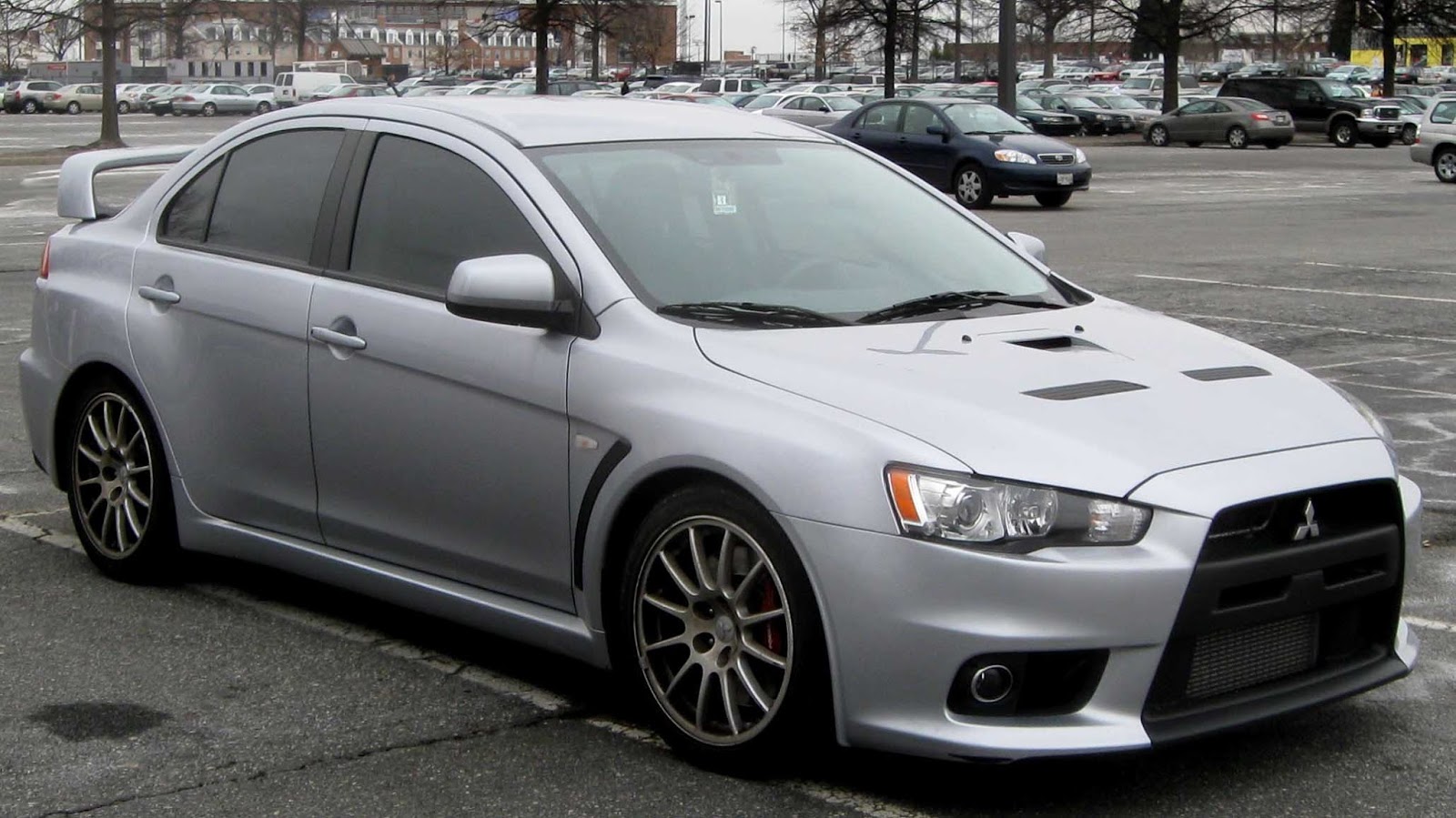
The Mitsubishi Lancer Evolution, also known as the Lancer Evo, Lan Evo, or just Evo, is a high performance sports sedan manufactured by Mitsubishi Motors that is based on the normal Lancer. There have been ten official versions to date, and the designation of each model is most commonly a Roman numeral. All use two litre, turbocharged engines and all-wheel drive systems.


In 2005, Mitsubishi introduced a concept version of the next-gen Evolution at the 39th Tokyo Motor Show named the Concept-X,[18] designed by Omer Halilhodžić at the company's European design centre.

Mitsubishi unveiled a second concept car, the Prototype-X, at the 2007 North American International Auto Show (NAIAS).


The Lancer Evolution X sedan features a newly designed 4B11T 2.0L (1998cc) turbocharged, all-aluminium inline-4 GEMA engine. Power and torque depend on the market but all versions will have at least 280 PS (206 kW; 276 hp). (JDM version), the American market version will have slightly more. The UK models will be reworked by Mitsubishi UK, in accordance with previous MR Evolutions bearing the FQ badge. Options for the UK Evolutions are expected to be between 300 hp (220 kW) and 360 hp (270 kW).

Two versions of the car are offered in the U.S. The Lancer Evolution MR, with 6-speed Twin Clutch Sportronic Shift Transmission (TC-SST). The other version is the GSR which has a 5-speed manual transmission system. The car also has a new full-time four-wheel drive system named S-AWC (Super All Wheel Control), an advanced version of Mitsubishi's AWC system used in previous generations.[21] The S-AWC uses torque vectoring technology to send different amounts of torque to the rear wheels.
It also features Mitsubishi's new sequential semi-automatic six speed SST twin-clutch transmission with steering-mounted magnesium alloy shift paddles. It has replaced the Tiptronic automatic transmission, hence the SST version replaced the GT-A version (which was used in Evolution VII and Evolution IX Wagon). A five speed manual gearbox will also be available. The new Lancer Evolution will also incorporate Mitsubishi's next generation RISE safety body.
The Evolution X went on sale October 1, 2007 in Japan,[22] January 2008 in the USA,[23] February in Canada (as the first version of Evolution in Canada)[24] and in March 2008 in the UK.[25] The Twin Clutch SST version was available in Japan from November 2007.[26] Europe will follow with sales in May, GSR and MR version included premium Package. The introduction of the 2010 MR-Touring moved the car even further upscale. Leather and a Moonroof became standard while revising the rear spoiler to just a lip spoiler.

Japanese models

The engine is the 4B11T-type 2.0 litre inline-4 turbo engine. The Evolution X can accelerate from 0–100 km/h in 4.5 to 4.7 seconds. Aluminum is used in the roof panel, hood, front fenders and the rear spoiler frame structure.[27] The launch model's engine was rated at 280 PS (206 kW; 276 hp) @ 6500 rpm and 422 N·m (311 lb·ft) @ 3500 rpm. Following the repeal of the 276 horsepower Gentleman's Agreement in Japan,[28] engine power was raised to 300 PS (221 kW; 296 hp) @ 6500 rpm beginning in 2009 model year.
  • RS – 5 speed manual transmission. 16-inch wheels.
  • GSR – Standard rear spoiler. 5-speed manual or 6-speed Twin Clutch SST transmission (magnesium paddle shifters on SST model). 245/40R18 Yokohama ADVAN A13C tire on Enkei 12-spoke high-rigidity cast alloy wheels or optional BBS lightweight alloy wheels. Brembo ventilated disc brakes. Standard S-AWC 4WD system. Driver and front passenger dual-stage airbag. Standard Engine immobilizer with security alarm. Optional Mitsubishi Motors Communication System (MMCS) which comprises a 30Gb hard disk drive audio/navigation system with 7 in (180 mm) LCD screen. Optional Rockford Fosgate premium sound system. Optional keyless remote entry.
GSR can be fitted with following packages:
  • High Performance Package – Bilstein single tube shock absorbers and Eibach coil springs, brembo 2-piece disc brakes, high performance tires with stiffer walls and better grip.
  • Stylish Exterior Package – Chrome finish for the front grille lattice and beltline molding, body color-keyed fender vents, adds fog lamps.
  • Leather Combination Interior – The seats match the color of the exterior.
  • Premium Package – All 3 above packages plus 18 in (457 mm) BBS lightweight alloy wheels.
  • GSR-Premium – Replacement of Premium Package beginning with 2009 model year, but added MMCS and Rockford Fosgate premium audio.
  • GSR Tuned by RALLIART – The Ralliart version was launched again in 2007, this limited edition for Lancer Evolution X is exclusively tuned by Mitsubishi Ralliart Japan equipped with 5 speed manual transmission, Ralliart RA04 Wheels 18 inch forged 1-piece black aluminum sport wheels paired with Yokohama ADVAN Neova AD08 tires. Aerodynamic parts include a newly designed carbon fiber front underspoiler, hood air dam, and front bumper air intake duct, and the intake and exhaust system has been tuned to get the best out of the engine. The interior is fitted with a motor sport shell-type full bucket seat jointly developed with Recaro. Official Ralliart livery was included in the packege together with Rockford Fosgate premium sound system with Mitsubishi Motors Communication System (MMCS) which comprises a 30Gb hard disk drive audio/navigation system with 7 in (180 mm) LCD screen. Its highly tuned 4B11T engine has maximum power output of 224 KW (300 bhp/ 304 ps) or more.[29]
  • Final Edition - A send-off version comprising the last 1000 units to be built. Based on the Evo GSR, this five-speed-manual-only edition comes with black leather Recaros with red accent stitching, 18-inch BBS wheels, Bilstein and Eibach suspension bits, and Brembo brakes, along with the requisite "Final Edition" badging and a numbered dash plaque.[30]

North American models

Engine produces 295 PS (217 kW; 291 hp) @ 6500 rpm and 407 N·m (300 lb·ft) @ 4400 rpm.
  • GSR – Same as base Japanese GSR with large spoiler. (available only with manual 5 speed)
  • MR – 6-speed TC-SST transmission. Suspension with Eibach springs and Bilstein struts. 18-inch BBS forged alloy wheels. Xenon High-Intensity Discharge (HID) headlamps. Color-keyed large rear spoiler. Leather and sueded seating. Electronic keyless entry and starting system. Steering wheel-mounted audio controls. Bluetooth hands-free cellular phone interface system with voice recognition.
  • MR Premium – MR with a Rockford Fosgate Navigation/Stereo with 9 speakers.[31]
  • MR Touring – (2010) Major differences from the MR are the rear-lip spoiler, heated full-leather seats, upgraded interior trim, and a power-sunroof on a steel roof.
  • SE – (late 2010–11) Is a combination of all three 2010 models; some key features are the GSR front grill and interior, MR rear diffusers, 6-speed TC-SST transmission, Eibach springs and Bilstein struts, MR touring rear-lip spoiler, and heated seats. Only 340 were produced in the United States. A special key fob with the series number and a letter of acknowledgement from Shin Kurihara were given to the purchaser of this trim.
  • Special Action Model (SAM) – (2015) All Lancer Evolution SAM models will be getting new heated side view mirrors with turn indicators and drop cup holder with lid. Production will be limited to 2,000 to 2,500 units and will be exclusively produced for the United States. Mitsubishi states that Special Action Model will mark the end of production of Lancer Evolution model.[32][33]
Option packages:
  • (GSR only) Sight, Sound and Spoiler Package – Xenon HID headlamps with manual leveling; large rear spoiler (starting in 2011, the large rear spoiler is standard in all models); FAST-Key electronic entry and starting system; 750-watt (maximum) Rockford Fosgate audio system; in-dash 6-disc CD changer; Sirius Satellite Radio with three months prepaid subscription.
  • (GSR - Canada only) Handling package - Bilstein Shocks, Eibach springs, 2 piece front rotors, forged BBS wheels, large spoiler.
  • (MR and MR Touring) Technology Package: Mitsubishi Multi Communication System, GPS navigation with Diamond Lane Guidance; 30GB hard disc drive with Digital Music Server, in-dash DVD/CD player, multifunction 7-inch (180 mm) color LCD touchscreen, 650(710 for 2010 model)-watt (maximum) Rockford Fosgate high-performance audio system, Sirius Satellite Radio with six months prepaid subscription.

UK models

UK cars kept the Evolution X name.
  • GS – Base Japanese GSR with Enkei or BBS wheels, 5-speed manual transmission\ radio and music server (MMCS), Rockford Fosgate premium audio, iPod/MP3 auxiliary input port.
  • GSR SST (FQ-300, FQ-330) – GSR FQ-300 with 6-speed TC-SST transmission with SST mode selection (normal, sport, super sport). GSR SST FQ-330 was released in 2009.[34]
Variants:
  • FQ-300 – Engine rated 300 PS (220 kW; 300 hp) at 6500 rpm and 407 N·m (300 lb·ft) at 3500 rpm.
  • FQ-330 – Engine rated 329 PS (242 kW; 324 hp) at 6500 rpm and 437 N·m (322 lb·ft) at 3500 rpm.
  • FQ-360 – Engine rated 359 PS (264 kW; 354 hp) at 6500 rpm and 492 N·m (363 lb·ft) at 3500 rpm. Carbon fibre front lip spoiler, rear vortex generator, gear knob, hand brake. Front leather Recaro seats.
  • FQ-400 – Engine rated 410 PS (300 kW; 400 hp) and 542 N·m (400 lb·ft) of torque. It also includes 5 speed manual transmission, six-piston brake calipers, upgraded brakes and 18-inch wheels fitted with Toyo Proxes R1R tyres (summers) or Toyo Snowprox S953 tyres (winters), a new aero kit that includes additional cooling intakes, vents, a larger air intake in the hood and ducts. An estimated 100 vehicles would be made.[35] It accelerates 0–62 mph in 3.8 seconds (est.) and has a top speed of 155 mph (electronically limited).
    Standard equipment for the range-topping Lancer Evolution X model is comprehensive, the FQ-400 coming with Bluetooth hands-free telephone connection, a CD-tuner with 30 GB hard drive, DVD satellite navigation and privacy glass. Convenience features like remote central locking, automatic headlamps and windscreen wipers increase the FQ-400's ease of use. Available from June 2009, the FQ-400 is covered by a three-year / 36,000 mile warranty. Cost £49,999 (list price).[36]
  • FQ-440 MR – Engine rated 450 PS (330 kW; 440 hp) Released in 2014 as a special edition with only 49 units available. It was available in only the Frost White colour priced at £50,000.

European models

Acceleration: 0–100 km/h 4.8 sec. with 1560 kg, 4.9 sec. with 1600 kg. Engine rated 295 PS (217 kW; 291 hp) at 6500 rpm and 366 N·m (270 lb·ft) at 3500 rpm.
  • GSR – 5 speed manual (GSR 5 M/T) or 6-speed TC-SST transmission (GSR TC-SST).
  • MR TC-SST – 6-speed TC-SST transmission. Suspension with Eibach springs and Bilstein struts. 18-inch BBS forged alloy wheels. Xenon High-Intensity Discharge (HID) headlamps. Mitsubishi Multi Communication System.

Brazillian models

The Lancer Evolution X arrived in Brazil in 2008 and is sold only with the twin-clutch transmission.
  • GSR - 6 speed TC-SST transmission, 18-inch BBS forged alloy wheels, Recaro racing seats, 7-inch multimedia system.
  • 2015 John Easton Edition - Specially created to the Brazilian market, this last edition comes with a 340 CV (335 hp), 48,5 Kgf.m (475 N.m) engine, grill outline in red and is limited to 90 units.

Australian / New Zealand models

Engine rated 295 PS (217 kW; 291 hp) at 6500 rpm and 366 N·m (270 lb·ft) at 3500 rpm.
  • GSR – 5 speed manual or 6-speed TC-SST transmission.
  • MR – 6-speed TC-SST transmission. Suspension with Eibach springs and Bilstein struts. 18-inch BBS forged alloy wheels, 2 piece front brake, aluminium rear spoiler, auto leveling Xenon High-Intensity Discharge (HID) headlamps. Mitsubishi Multi Communication System, leather combination seat trim, heated front seats.
  • Bathurst Edition – A Team Mitsubishi Ralliart Australia upgraded/tuned version Evolution X with a rated power output of 336 PS (247 kW) and 436 Nm of torque. The Team Mitsubishi Ralliart (TMR) Bathurst Edition is the most powerful road-legal Lancer Evolution X to be offered in Australia as a new car. The Bathurst Edition is available with either the standard 5-speed manual or the quick-shifting TC-SST twin-clutch 6-speed, with a limited run of only 100 units. It is covered by the MMAL factory warranty.
  • Final Edition - A send-off version comprising the last 1000 units to be built and 150 will be diverted to Australian and only 30 also made available in New Zealand. Based on the Evo GSR, this five-speed-manual-only edition comes with black leather Recaros with red accent stitching, 18-inch BBS wheels, Bilstein and Eibach suspension bits, and Brembo brakes, along with the requisite "Final Edition" badging and a numbered dash plaque. This model has 'Enhanced engine power' (over the GSR model) with 226 kW power and 414Nm of torque.[37]

Southeast Asian models

Philippine models

The Philippines received its Evolution X in November 2008, and is the same as the USDM versions. The trims and specs are almost the same, excluding the MR Touring model from the USDM.
  • GSR- 5-speed manual, and the same specs with the USDM GSR with large spoiler.
  • MR- 6-speed TC-SST gearbox, and the same specs with the USDM MR, excluding the Technology Package.

Malaysian models

In Malaysia, the Lancer Evolution X is available with only a 6-speed Twin Clutch SST transmission. Front license plates are aligned towards the center or right of the fascia. In 2009, the Royal Malaysian Police acquired a fleet of the Lancer Evolution X to be used in high-speed pursuits.

Future

In March 2011, rumours of discontinuation of the Lancer Evolution program started when AutoCar UK's journalist Matt Prior wrote on his interview with Gayu Eusegi, Mitsubishi's Global Product Director, and quoted him saying 'The Lancer Evolution X, Eusegi told me, will be the last Evo. "There is still a demand [for the car]," he said, "but we must stop." Eyebrow up.'[38] This created a lot of discussion on the Internet.
Mitsubishi Motors would later state that "Further to some comments published in the press recently, production of the current Lancer Evolution continues as planned. As for its successor, regulations and market feedback will dictate its engineering package & architecture. Stay tuned.." Industry analysts would read the statement as indirectly hinting that the Evolution nameplate will remain, but is likely to be an environmentally friendly powertrain (possibly electric or hybrid), inline with increasingly stringent emission and environmental regulations.
AutoCar UK later updated its blog post, adding references to EV, further confirming what industry watchers originally speculated. Most recent news shows that Mitsubishi has been leaning towards the Mitsubishi Concept PX-MiEV hybrid drivetrain, explaining that the electric motors will act as a turbo for the Evolution. Mitsubishi claims that their more "green" version of the Evolution will be just as good or even better in the performance category.
In October 2011, the President of Mitsubishi Motors, Osamu Masuko, confirmed to AutoCar that work on the next Evo will start in 2012 and will go on sale within the following three years. It is said that the car will feature electric power from a hybrid drivetrain, maintaining performance of 0-62 mph time under five seconds while cutting CO2 emissions.[39]
The next generation of Mitsubishi Evo will be notably smaller than the last version according to company president Osamu Masuko.
In late March 2014, Mitsubishi spokeswoman Namie Koketsu issued a press release stating "Mitsubishi Motors does not have any plans to design a successor with the current concept, as a high-performance four-wheel drive gasoline-powered sedan. Mitsubishi Motors will explore the possibilities of high-performance models that incorporate electric vehicle technology.", marking Mitsubishi's exit from the manufacture of performance vehicles.[40]

Discontinuation


Mitsubishi stated that the Lancer Evolution would cease by end of March 2016, and the car-maker has chosen to focus on vehicles that incorporate electric technology. A "Final Edition" will be offered with special production number badges.